A Korean celadon ewer combines melon and bamboo forms so smoothly that the plant imagery becomes part of the vessel’s structure.
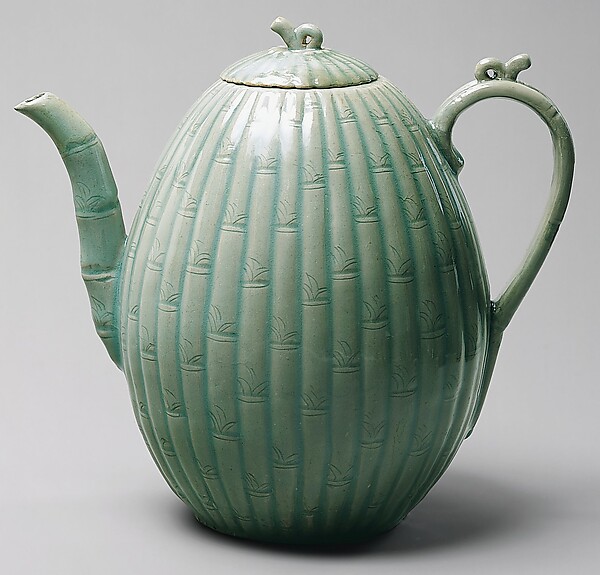
At first, the green vessel seems to be a single botanical idea: a melon turned into a pitcher. Then the details complicate it. Jointed bamboo-like forms run over the body and up the spout. A curved handle rises on the other side. This is a useful object assembled from more than one way of looking at plants.
Made in Korea in the first half of the twelfth century, the ewer belongs to the Goryeo dynasty. Its green surface is celadon glaze over stoneware, with carved and incised decoration beneath. At 21.6 centimeters high, it is large enough for its rounded body and slim attachments to create a clear contrast.
Nature becomes structure
The Met’s object record emphasizes the combination of melon and bamboo. Look at how the references are distributed. The fruit supplies volume: a full, lobed body that can contain liquid. The bamboo provides a language of slender lengths and joints. It carries the eye upward, toward the lid and the opening of the spout.
Nothing requires a painted picture of a melon beside a painted picture of bamboo. The forms have been absorbed into the vessel itself. That makes the botanical references discoverable through its outline and surface, even before a label names them.
The little projections near the lid and handle introduce another scale of detail. Against the large swelling body, they seem almost punctuation-sized. The design can be appreciated from across a room, but it also gives a close viewer something new to find.
The green is a material achievement
Celadon is not simply a color painted onto the finished pot. The Met’s history of Goryeo celadon explains how raw materials and kiln conditions produced its range of gray-green and blue-green hues. Iron-bearing materials in the body and glaze, together with reduced oxygen during firing, contributed to the result.
Korean potters adapted ceramic technologies from China and developed distinctive approaches to form and decoration. The history is one of exchange and invention, rather than a single recipe remaining unchanged. Celadon could be plain, carved, incised, or inlaid; this particular ewer is catalogued as carved and incised, so its decoration should not be mistaken for the black-and-white inlay found on other Goryeo wares.
A Met educational guide suggests that this vessel probably held wine. It may once have stood in a basin of hot water to keep its contents warm. The guide presents the basin as a possibility, not a surviving part of this object.
Even without reconstructing a table setting, the ewer is easy to understand as a negotiation between a hand and a liquid. One side offers a handle; the other directs a pour. Between them sits the melon’s generous volume. The natural references are doing useful design work, not merely filling an empty surface.
Object & sources
Melon-shaped ewer with bamboo decoration
first half of the 12th century · Stoneware with carved and incised design under celadon glaze
- The Met: Melon-shaped ewer with bamboo decoration
- The Met: Goryeo Celadon
- The Met: Arts of Korea, educator resource, object 12
Historical information is drawn from the linked museum records and research. Visual observations are Storied Spark’s own. Storied Spark is independent of the institutions cited.
Comments
Post a Comment