A snake-shaped bass instrument hides a practical design, an unusual painted skin, and the traces of the hands that played it.
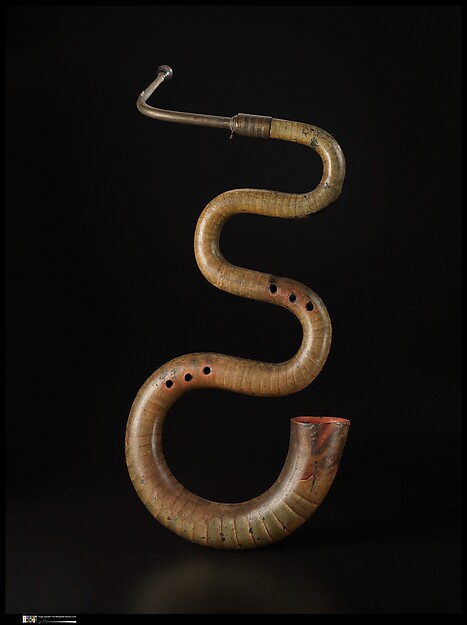
Why would a serious musician pick up something that looks like a snake halfway through a dance? Follow the bends of this instrument before you look at its label. The narrow mouthpipe at the top leads into a winding body that grows wider toward the open end. Six dark finger holes interrupt the painted surface. This creature has work to do.
A shape that brings the music within reach
This is a serpent made by C. Baudouin in Paris around 1820. The Met lists wood, leather, paint, and brass among its materials. Its curves are practical: they bring the finger holes into positions a player can reach. The painted, animal-like finish is unusual. Serpents were generally black, so this example gives the instrument's name an extra visual flourish. The museum record also identifies the worn areas around the holes as evidence of extensive playing.
The construction can be confusing if you sort instruments by appearance alone. A wooden body suggests woodwind, yet the serpent is played with a brass-style mouthpiece. Oxford's Bate Collection places it in the family of lip-vibrated wind instruments and describes its descent from the cornett. Developed in France to accompany church plainsong, the serpent later found places in military bands and orchestras. A body that looks fantastical belonged to a useful, adaptable bass voice. Read the Bate Collection's account.
Look where the surface changes
Here is a close-looking exercise rather than a reconstruction of a particular performance. Start at the bottom, where the wide curve makes a nearly enclosed loop. Let your eye travel upward. The middle bends are tighter, while the metal pipe at the top extends sideways like a small finishing stroke. The whole silhouette has the easy rhythm of a line drawn without lifting the pencil.
Now interrupt that flowing line with the holes. They form two little groups, making the absent player's hands surprisingly easy to imagine. The lighter and darker patches nearby are more compelling than a uniformly fresh surface would be. They change the object from an ingenious shape into something people repeatedly held.
We cannot recover a player's name or a favourite tune from those patches. What we can see is a meeting between design and use. The maker arranged the body for human hands; repeated contact altered the finish. Both contributions remain visible, even when the instrument is silent. Looking for that second layer can change how you notice ordinary objects, too: a smooth spot on a wooden handle, a softened book corner, a shiny patch on a door latch.
Try this: draw the invisible user
Choose an everyday object with visible wear. Sketch only its outline and the places that have changed through handling. Beside each mark, write a verb: turn, grip, rest, open. Then draw an imaginary version shaped around those actions. A mug might curve toward a thumb; a notebook might open around a favourite page. Treat this as a design experiment, not a claim about the object's past. The serpent offers a useful starting question: what would a tool look like if its silhouette revealed the way we move?
Object & sources
Serpent
C. Baudouin · ca. 1820
Wood, leather, paint, brass
The Metropolitan Museum of Art, Purchase, Robert Alonzo Lehman Bequest, 2012. Object 2012.568a–c.
Image: The Metropolitan Museum of Art, Open Access, public domain under CC0. Download the museum image.

Historical statements follow the linked institutional sources. Close-looking interpretations and the creative exercise are original Storied Spark contributions, not claims about a maker's intentions. Storied Spark has no museum affiliation.
Comments
Post a Comment