A palm-sized Chinese gourd container opens a history of cricket-keeping, seasonal materials, and miniature crafted environments.
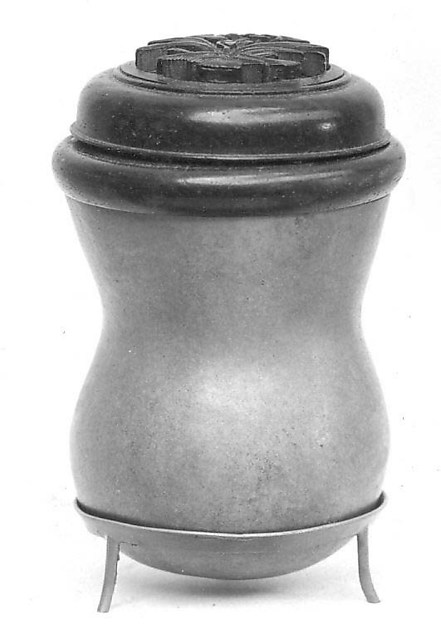
The photograph offers a small, quiet object: a narrow-waisted container, a dark rim, and a pierced cover. Its label supplies the missing sound. This was a cage for a cricket.
Made in China in the eighteenth or nineteenth century, the container is only 8.6 centimeters high. The Met lists its materials as gourd and wood. Nothing about its modest scale prepares us for the range of attention historically devoted to the insects it could house.
A container for listening
Cricket-keeping in China included the pleasure of hearing the insects. The Minneapolis Institute of Art’s account of a related container describes domestic cricket-keeping in the Tang dynasty and its development as a scholarly pastime by the Ming. It also notes the existence of numerous writings on varieties and care by the eighteenth century.
The choice of material could respond to the season. Mia explains that gourd containers were used in winter because they were warmer than ceramic alternatives used in summer. The gourd was therefore more than an appealing organic shape. Its material properties were part of the object’s purpose.
That is context for the type, not a diary of this particular cage. The Met does not identify its owner, an individual insect, or a room where it was kept. The surviving object offers a history of materials and craft, while leaving the circumstances of its use open.
A plant becomes an interior
Look again at the Met’s photograph. The smooth central body narrows, then broadens toward its upper and lower edges. The dark wooden fitting gives the opening a more emphatic boundary. Piercing in the cover supplies a different texture from the uninterrupted sides.
The monochrome image does not let us confidently reconstruct the object’s original colors. It does make the relationship between rounded volume and fitted top unusually clear. A natural material has been brought into a precise partnership with a worked component.
Other surviving cages show how far that partnership could be developed. The Saint Louis Art Museum holds a cage described as molded gourd with a wood rim, while the Mia example bears a scene burned into the gourd with a heated stylus. These are different objects and different surface treatments. Neither technique should automatically be assigned to the plainer Met cage.
The comparison reveals the range within an apparently narrow category. A container could be selected for seasonal use, fitted with a carefully made opening, and ornamented as a surface for looking. An activity centered on sound generated objects worth studying in their own right.
It is tempting to photograph a vessel and assume that its visible shape tells the whole story. Here the essential dimension cannot be shown at all. The little gourd was designed around a living occupant and an experience of listening. The empty museum object asks us to notice that absence without pretending we can fill it in exactly.
Object & sources
Cricket cage
18th–19th century · Gourd, wood
- The Met: Cricket cage, 28.186.49
- Minneapolis Institute of Art: Cricket Container, 96.69.1a,b
- Saint Louis Art Museum: Cricket Cage with Design of Figures
Historical information is drawn from the linked museum records and research. Visual observations are Storied Spark’s own. Storied Spark is independent of the institutions cited.
Comments
Post a Comment