Slanting rain, bending bamboo, and hurried travelers make Hiroshige’s Shōno print feel like weather arriving all at once.
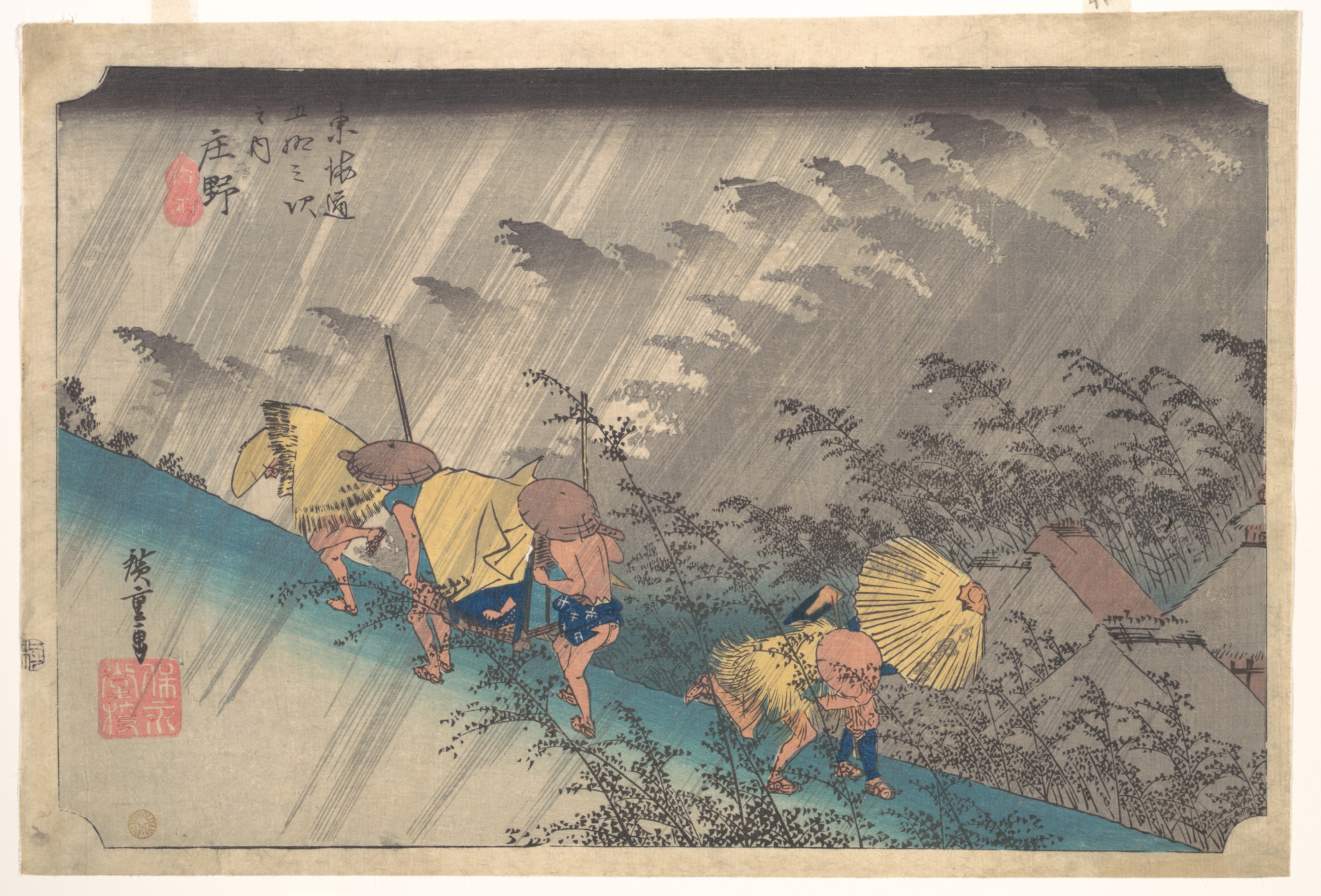
The rain does not sit in the background. It crosses everything. Thin, slanting lines cut through sky, bamboo, people, and road, turning separate parts of the picture into one shared inconvenience. In Hiroshige’s Sudden Shower at Shōno, the weather is the strongest organizing force.
The print belongs to his Fifty-three Stations of the Tōkaidō series. The Met dates this impression to 1834–35. The Tōkaidō connected Edo, now Tokyo, with Kyoto; its post stations provided travelers with food, lodging, and other services. The University of Michigan Museum of Art places the popularity of such landscapes within the growing culture of travel and travel imagery.
A place can be named without being copied exactly
The Met adds an important qualification: Shōno did not offer a view matching the landscape in the print, and the design appears to be imaginary. We should therefore resist treating it as a precise weather report or a literal view drawn from one roadside position. The named place provides a setting; the composition makes an experience.
The steep diagonal of the road gives the travelers an immediate problem. Some climb into the picture while others hurry toward the lower right. Bent backs and raised legs make their movement legible at a small scale. The figures do not need large faces or detailed expressions to communicate effort.
The bamboo answers the people’s gestures. Its dark shapes bend and sweep behind them, while paler forms recede into the storm. The effect is more than a decorative background. Human bodies and vegetation appear to encounter the same force, so the weather feels continuous across the scene.
Two kinds of line
Look at the difference between the long, repeated rain marks and the shorter, more irregular outlines of clothing and foliage. The rain has a persistent direction. The people respond with compressed, uneven shapes: a tucked head, an angled load, an umbrella held low. Order and scrambling occupy the same sheet.
The yellow umbrella near the lower right also carries something unexpectedly practical. The Met identifies its inscriptions as the publisher’s family name, Takenouchi, and part of the series title, meaning “fifty-three stations.” The object that shelters a traveler also makes room for a publishing reference. It belongs to both the represented road and the printed product in our hands.
Those marks are a reminder that the apparent immediacy was manufactured. This is a woodblock print, made in ink and color on paper. Its passing shower depends on stable, repeatable lines. A fleeting sensation has been organized carefully enough to survive repeated printing.
Try sketching an ordinary outdoor scene twice: first without weather, then with one dominant direction running through it. Let a tree, a coat, and a person’s posture respond to that direction. Hiroshige’s example suggests that convincing weather involves more than drawing rain in the sky. It changes the way everything else occupies the picture.
Artwork & sources
Sudden Shower at Shōno, from the series Fifty-three Stations of the Tōkaidō
Utagawa Hiroshige · 1834–35
Woodblock print; ink and color on paper
The Metropolitan Museum of Art. Rogers Fund, 1914. Object JP41.
View the collection record. Image: Public domain; The Met Open Access, CC0.
Historical details are grounded in the linked collection records and museum research. Visual interpretations and any creative exercises are original Storied Spark contributions. Storied Spark is independent of these institutions.
Comments
Post a Comment