Under a row of gaslights, Seurat turns a free circus attraction into a measured arrangement of figures, shadows, and color.
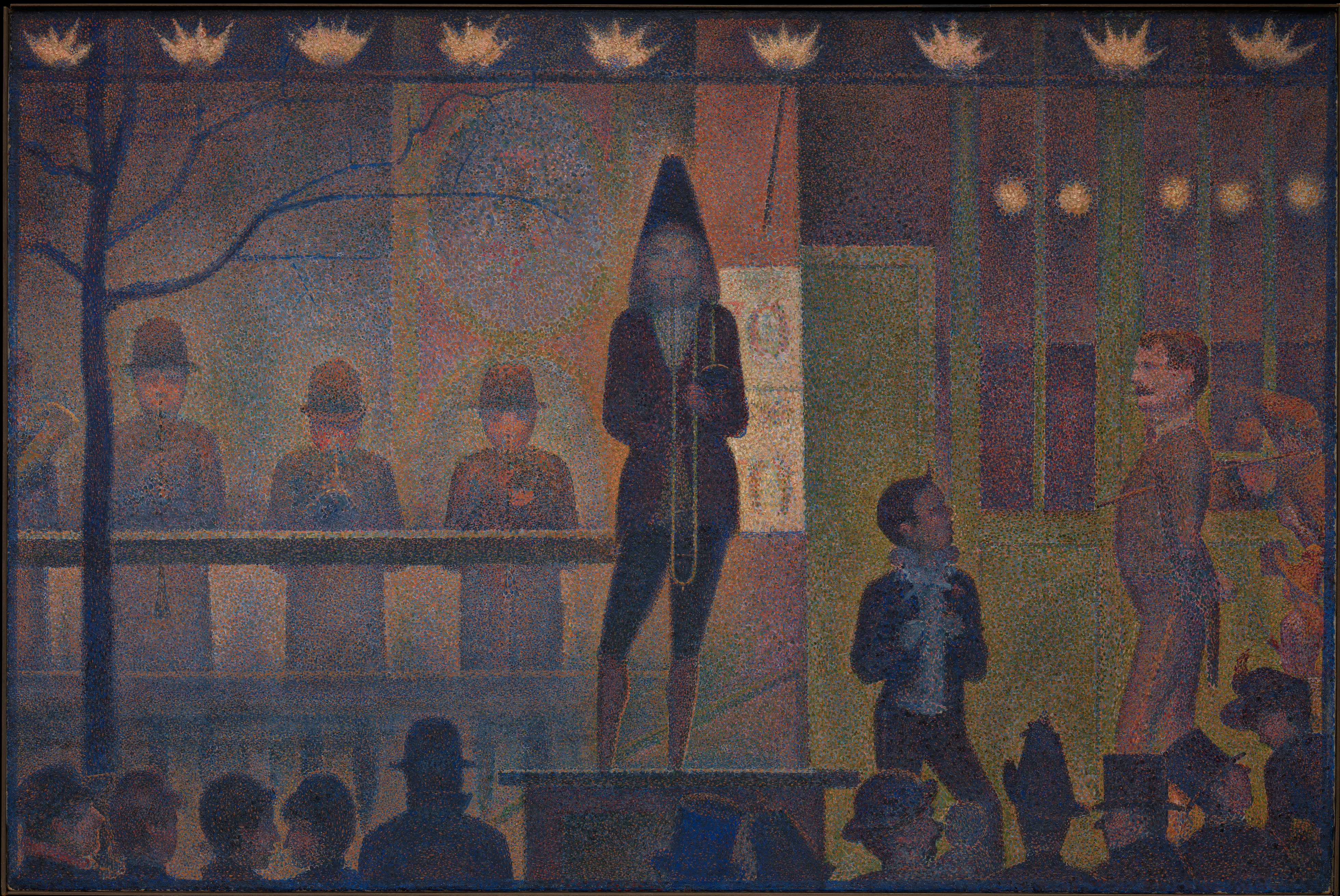
A circus is supposed to attract attention. Yet the performers in Georges Seurat’s Circus Sideshow seem held in place. The central musician stands almost like a vertical mark on a chart. Faces emerge through dim color. Across the bottom, spectators form a broken band of hats and heads.
Painted in 1887–88, the scene represents the Circus Corvi at the Gingerbread Fair near the place de la Nation in Paris. The Met explains that this performance took place outside the tent. It was free entertainment intended to persuade passersby to buy tickets; the figures climbing at the right approach the box office.
Outside the main event
Knowing that setting changes the picture. We are watching an invitation to a show, rather than the show inside. Seurat has chosen the threshold where public attention might become paid admission. The performers and customers occupy the same little system, but their jobs are different.
The stage is divided by upright posts, a rail, and the horizontal line above the performers. These elements make a framework before we begin identifying individual people. The dark, central trombonist interrupts it without breaking its order. His tall hat and narrow stance extend the sense of verticality; the instrument adds a curve to an otherwise stiff arrangement.
In front, the audience is less regular. Hats rise to different heights, and heads overlap. Look at the interval between this irregular lower border and the more controlled stage. The shallow gap is enough to suggest two kinds of behavior: people gathered to watch, and people presenting themselves to be watched. That is a reading of the arrangement, rather than a report of anyone’s thoughts.
Light that does not clear the darkness
Nine gaslights run above the scene, according to The Met’s exhibition account. Their small flames announce illumination, but the painting remains difficult to read at a glance. Faces and clothing hold unusual neighboring colors. The tiny touches of paint keep the surface active even when the people appear still.
Seurat exhibited this outdoor night scene in 1888 alongside Models, an interior in daylight. The pairing matters because his method had to do more than make a bright afternoon shimmer. Here, separate touches of color describe limited visibility and artificial light. The image asks us to look into darkness without expecting it to become transparent.
The Met’s curators emphasize the contrast between the loud promotional spectacle and Seurat’s ordered treatment. On the page, that contrast can be tested directly. Imagine the same subject with wide-open mouths, waving arms, and a crowded diagonal rush. Seurat’s small gestures and firm divisions would be lost, and with them much of the scene’s peculiar suspension.
What holds the picture together is not a single entertaining incident. It is the spacing: light after light, upright after upright, face after face. The public performance pauses long enough for its structure to show. Even the invitation to hurry inside becomes something we can stand outside and examine.
Artwork & sources
Circus Sideshow (Parade de cirque)
Georges Seurat · 1887–88
Oil on canvas
The Metropolitan Museum of Art. Bequest of Stephen C. Clark, 1960. Object 61.101.17.
View the collection record. Image: Public domain; The Met Open Access, CC0.
Historical details are grounded in the linked collection records and museum research. Visual interpretations and any creative exercises are original Storied Spark contributions. Storied Spark is independent of these institutions.
Comments
Post a Comment