A tiny jewelled chariot from 1766 reveals a world of hidden mechanisms, travelling luxury, and craftspeople behind one famous name.
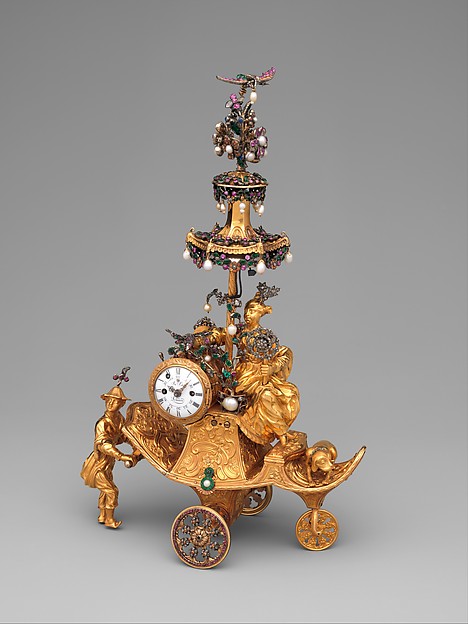
How much entertainment can fit around a clock face? In this miniature chariot from 1766, the dial is only one attraction. A seated woman, an attendant, jewelled flowers, wheels, and a tall parasol compete for attention. The entire object stands just 26 centimetres high. It promises a performance before anything begins to move.
A spectacle with hidden connections
The Met identifies the object with James Cox's London enterprise. It was one of a pair presented by the English East India Company to the Qianlong emperor. An account published in 1766 described a bird that fluttered, a rotating ornament, and a bell beneath the parasol that sounded the hours. Mechanisms connected parts that appeared separate. The museum also notes that two birds described at the front of the chariot are now missing. These are historical descriptions of its effects, not a claim that every mechanism works today. The collection entry traces the account and the surviving object.
The materials support the show: gold, pearls, diamonds, and paste jewels appear alongside enamel, brass, and steel. Glitter attracts the eye while mechanical components do the concealed work. In a photograph, the distinction is especially tantalising. You can inspect the richly worked exterior, but you cannot watch the sequence that once gave it another dimension.
The people behind the signature
Cox's name does not mean he personally made every part. Museum historians Clare Vincent and J. H. Leopold describe him chiefly as an entrepreneur drawing on independent craftspeople and suppliers. Many remained unnamed. There is no evidence that Cox himself made a watch movement, and his precise contribution to designs remains uncertain. His business exported elaborate luxury objects to India and China; the Qianlong emperor's interest in clocks helped create an audience for such inventions. Read their account of Cox's career.
That changes how the object can be read. The famous name is a way into the story, but the complicated result also points toward skills distributed across many hands. Its success depended on bringing those contributions together. We can recognise that collaboration without supplying imaginary biographies for the people whose names are missing.
Look for the stage directions
Here is our visual interpretation. The composition rises through distinct levels: wheels, chariot, figures, parasols, and the small winged form at the top. The white dial interrupts the gold like a clearly lit stage. Pearls hanging beneath the canopy soften its edges, while the large wheel's open pattern provides a second circular focus below.
Even without seeing it operate, your eye keeps finding reasons to move. That gives the object a useful lesson for anyone arranging a display or telling a short story: a sequence of discoveries can be more engaging than revealing everything with equal emphasis at once.
Try this: storyboard a tiny surprise
Draw three frames for an imaginary paper theatre. In the first, establish a simple scene. In the second, let one small element change: a window opens, a bird turns, a flower appears. In the third, reveal how that change connects to something elsewhere. You do not need gears or electronics; a folded flap or sliding paper tab is enough. Aim for a clear cause and a delightful result. Cox's chariot suggests the pleasure of a hidden connection made visible at just the right moment.
Object & sources
Automaton in the form of a chariot pushed by a Chinese attendant and set with a clock
James Cox · 1766
Case: gold with diamonds and paste jewels set in silver, pearls; Dial: white enamel; Movement: partly gilded brass and steel, wheel balance and cock of silver set with paste jewels
The Metropolitan Museum of Art, The Jack and Belle Linsky Collection, 1982. Object 1982.60.137.
- The Met: James Cox, chariot automaton with clock, 1766
- Clare Vincent and J. H. Leopold, The Met: James Cox, Goldsmith and Entrepreneur
Image: The Metropolitan Museum of Art, Open Access, public domain under CC0. Download the museum image.

Historical statements follow the linked institutional sources. Close-looking interpretations and the creative exercise are original Storied Spark contributions, not claims about a maker's intentions. Storied Spark has no museum affiliation.
Comments
Post a Comment