An eighteenth-century British teapot turns a humble vegetable into an ingenious meeting of texture, colour, and everyday function.
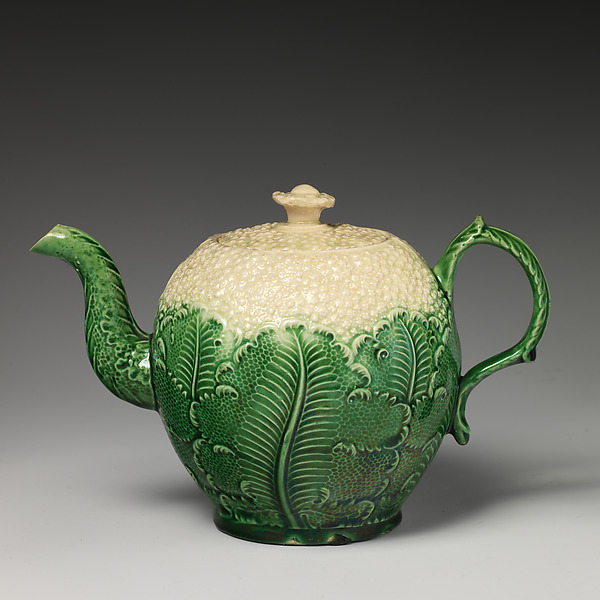
Would you expect a cauliflower to pour tea? This little pot makes the question feel reasonable. Cream-coloured florets cover its upper body, green leaves gather around the sides, and a familiar handle and spout complete the transformation. You can recognise the vegetable and the teapot at the same time. Neither identity quite wins.
A vegetable in the drawing room
The Met dates this British teapot to around 1755–70. It is made of lead-glazed earthenware and stands only about 11 centimetres high. The museum does not identify a maker in the record, so it is better to enjoy the design without attaching a famous potter's name. Its compact size makes the amount of surface detail even more striking. See the original object record.
Tea utensils belonged to a much larger social world. The V&A describes how fashionable tea-drinking in eighteenth-century Britain created demand for carefully chosen pots, caddies, cups, and other accessories. These objects could express taste and status as well as serve a drink. The same history also connects the increasing availability of sugar with colonial exploitation and enslaved labour in Caribbean plantations. A charming object can be appreciated while remembering that the world of the tea table was not equally comfortable for everyone. The V&A's history supplies that wider context, without establishing who owned this particular pot.
Look at how the disguise works
The following is a visual reading of the photograph. Notice that the colour scheme has only two main jobs. Green describes the enclosing leaves, while cream describes the clustered head. The broad division is legible from a distance. Close up, the modelling takes over: leaf veins branch outward, edges curl, and small raised bumps crowd the pale surface.
That shift between a simple overall shape and busy detail keeps the design from becoming muddled. The body is almost a plain rounded vessel underneath its botanical costume. Its silhouette remains easy to read, even while the surface invites another look.
The handle does something slightly different. It resembles a slender branch rather than a chunky piece of cauliflower. The spout also extends the green outside the rounded body. These parts do not make a strictly realistic vegetable, but they make the hybrid convincing. Instead of insisting on complete imitation, the design finds places where plant-like forms and useful teapot parts can meet.
Try covering the handle and spout with your fingers while looking at the image. Then uncover them. The same central shape shifts from produce to domestic object. That tiny reveal is the joke, and it does not need a caption to work. This is our interpretation of the design's effect, not a recorded explanation from its unknown maker.
Try this: borrow a vegetable's structure
Choose one piece of fruit or a vegetable and draw three things from it: the overall outline, one repeated texture, and one interesting edge. Use those features to sketch a paper container, gift tag, or patterned card. A citrus segment might become a folded fan; an artichoke's overlapping leaves might become a border. Keep one part of the result plain so the borrowed detail has room to stand out. Make a quick paper version to see whether the idea works beyond a drawing. Sometimes the most useful discovery arrives when a flat shape begins to fold.
Object & sources
Teapot in the form of a cauliflower
Maker unknown · ca. 1755–70
Lead-glazed earthenware
The Metropolitan Museum of Art, Rogers Fund, 1928. Object 28.184.5a, b.
- The Met: Teapot in the form of a cauliflower, c. 1755–70
- Victoria and Albert Museum: Teapot design through time
Image: The Metropolitan Museum of Art, Open Access, public domain under CC0. Download the museum image.

Historical statements follow the linked institutional sources. Close-looking interpretations and the creative exercise are original Storied Spark contributions, not claims about a maker's intentions. Storied Spark has no museum affiliation.
Comments
Post a Comment