Anna Atkins’s blue algae print turns a small specimen into a lesson in spacing, silhouette, and attentive looking.
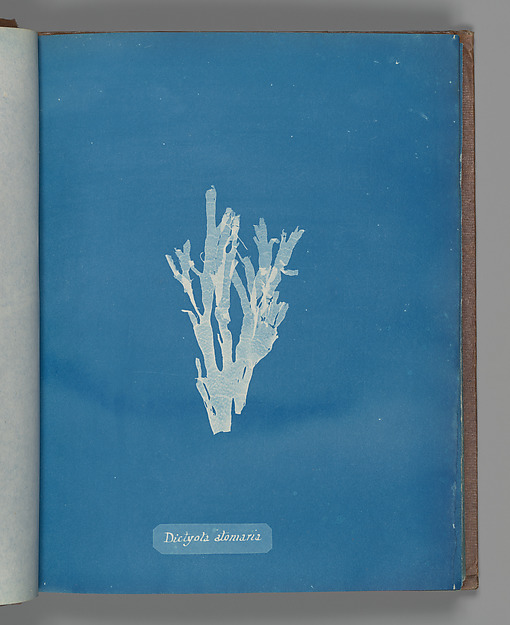
The first thing you notice may be the blue. A small, pale branching form sits within a generous field of it, separated from its handwritten name by another interval of empty paper. The specimen is modest. The attention offered to it is expansive.
A book made with light
Anna Atkins made this cyanotype, Dictyota atomaria, around 1853. It belongs to her project Photographs of British Algae: Cyanotype Impressions, issued in parts from 1843. The Met describes the album as the first book to be photographically printed and illustrated. Atkins placed algae on light-sensitive paper and exposed it to sunlight; the specimen itself helped produce the image. The museum’s album record explains the process.
This particular sheet is a useful reminder that early photography did not always involve a camera pointed at a scene. The physical contact between a specimen and a prepared surface could become a record. Its label also matters: Atkins’s undertaking was a botanical publication, even when a contemporary viewer approaches it first for its beauty.
Read the intervals
Look at the algae’s outer edge. Some branches stop abruptly; others split and climb. The silhouette feels irregular rather than ornamental. Inside it, differences in pale tone suggest a surface with more complexity than a flat white cutout. At this reproduction size, however, it would be unwise to assign a botanical explanation to every visible mark.
Now notice the blue passages between the branches. Each is a small shape of its own. A narrow opening stretches upward near the center, while broader spaces open toward the sides. The print becomes easier to look at when you alternate between the specimen and those surrounding shapes.
The separate label creates a second visual anchor. It gives your eye somewhere to land after following the branches. The large surrounding margin slows the movement between those two anchors. In our reading, this spacing makes a small object feel worth a long look. A crowded page would produce a very different pace.
Try it: change only the space
Place three pale paper silhouettes on a blue sheet. Sketch them crowded together, then spread them apart without changing their shapes. Add a small label beneath each one. Which arrangement feels more like a collection? Compare the gaps as carefully as the objects. This borrows Atkins’s page design, not her photographic process.
Artwork & sources
Dictyota atomaria
Anna Atkins · ca. 1853 · Cyanotype
The Metropolitan Museum of Art, Gilman Collection, Purchase, The Horace W. Goldsmith Foundation Gift, through Joyce and Robert Menschel, 2005. Object 2005.100.557 (19).
View the collection record. Image: Public domain / The Met Open Access (CC0).
Historical details are drawn from the linked collections. The visual reading and creative exercise are original Storied Spark contributions. Storied Spark is independent of these institutions.
Comments
Post a Comment