A diagonal walkway divides Stieglitz’s shipboard photograph, where formal geometry and the lives of passengers cannot be fully separated.
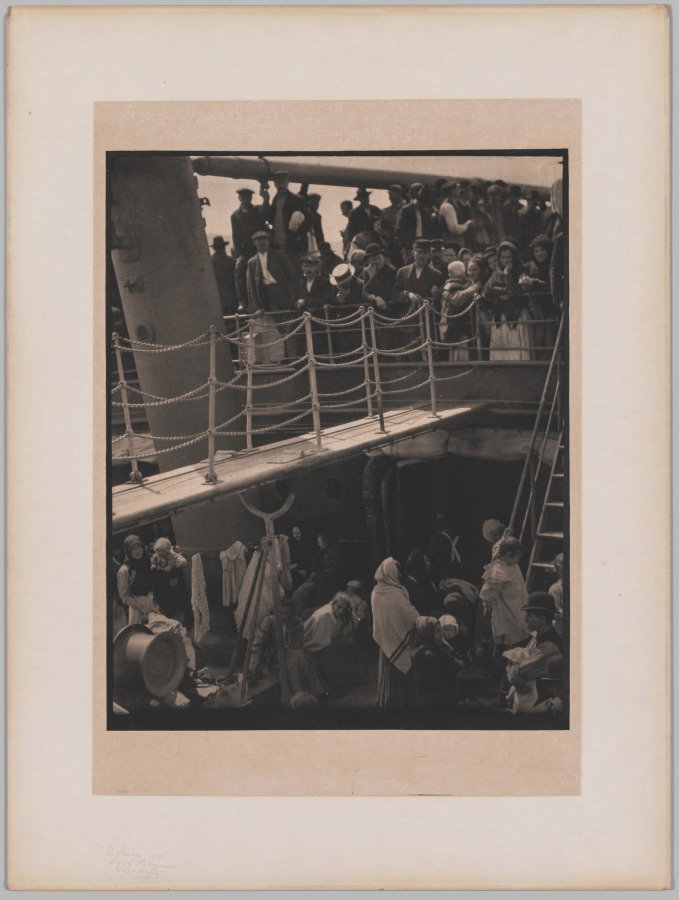
A bright walkway cuts across the picture. Above it, people gather behind a railing; below it, more figures occupy a darker, less orderly space. The diagonal gives Alfred Stieglitz’s The Steerage a structure we can grasp quickly. Understanding the people within that structure takes more care.
Stieglitz made the photograph during a journey to Europe in 1907, while traveling first class. The direction of travel is worth stating: this is not a ship arriving in the United States. The Cleveland Museum of Art describes the passengers as immigrants returning to Europe. The photograph alone, however, cannot tell us the circumstances or intentions of every individual shown.
A frame made of shipboard things
The gangway, chains, railings, and stairs create a strong network of lines. Some repeat; others cross them at sharper angles. Small pale shapes, including hats and clothing, punctuate the dark groups of people. The result can be read as an arrangement of planes and marks before it is read as a scene.
But those two readings do not remain separate for long. The lines belong to a working ship, and the dark and light shapes belong partly to people. A railing is both a graphic division and an object that limits movement. Our elevated view provides an overview while keeping us at a distance from the passengers.
That tension is central to the picture’s interest. Looking only for geometry can make the travelers seem like compositional material. Looking only for a social document can overlook how decisively the photograph directs attention. Neither description fully contains what is visible.
A photograph and its later story
The image’s reputation also developed over time. The Met notes that Stieglitz published it in Camera Work in 1911, four years after making it, and later issued large photogravures in 291. It did not enter public circulation with its entire future significance already attached.
In a much later account, Stieglitz presented the photograph as a crucial artistic revelation. National Gallery of Art scholar Sarah Greenough examines the problems in that retrospective story, including inconsistencies in its timing and circumstances. The safest conclusion is not that the picture lacks importance, but that an artist’s later memory is another source to examine, rather than a transparent replay of the original moment.
The print reproduced here adds a material detail. Cleveland identifies it as Stieglitz’s own lifelong copy. It is a photogravure: the photographed scene reaches us through a printed object with its own paper, margins, and history. The museum dates the work to 1907 without separately assigning this impression a printing date.
Return to the bright diagonal. It brings order to the crowded frame, but it does not explain all the lives around it. The photograph is compelling partly because its structure is so clear while its human information remains incomplete. Careful looking means noticing both the certainty of the lines and the limits of what those lines can tell us.
Artwork & sources
The Steerage
Alfred Stieglitz · 1907 (museum date; print date not separately specified)
Photogravure
The Cleveland Museum of Art. Gift of Diann G. Mann and Thomas A. Mann, 2019.22.
View the collection record. Image: Public domain; Cleveland Museum of Art Open Access, CC0.
- Cleveland Museum of Art: The Steerage
- The Met: The Steerage
- Sarah Greenough: The Key Set, 1902–1917
- Mark Levitch: Alfred Stieglitz, Career Overview
Historical details are grounded in the linked collection records and museum research. Visual interpretations and any creative exercises are original Storied Spark contributions. Storied Spark is independent of these institutions.
Comments
Post a Comment