Two birds share a sixteenth-century Iznik dish with a crowded garden of flowers, turning a round plate into a lively place to look.
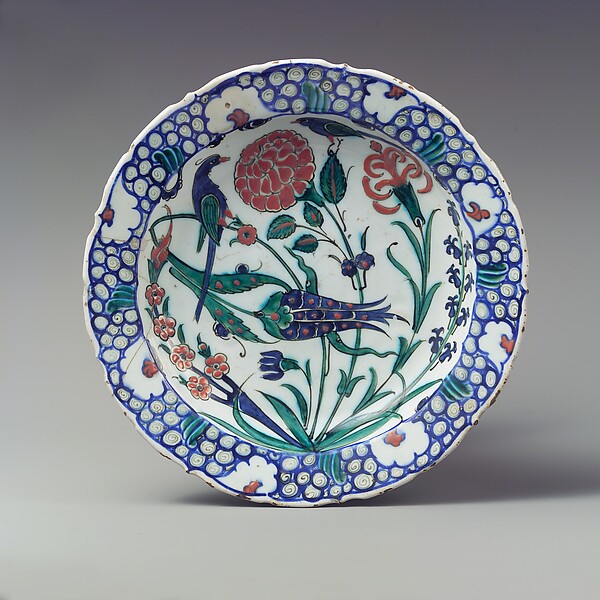
The first bird nearly announces itself. Its broad body and long tail occupy the center of the dish. The second is easier to miss, tucked into the busy growth toward the upper edge. Once you find both, the flowers stop being only a pattern and begin to feel like a place.
This dish was made in Iznik, in present-day Turkey, around 1575–90. The Met describes its material as stonepaste, painted in several colors beneath a transparent glaze. It is a ceramic object, but not Chinese porcelain, even though the history of Iznik pottery includes a sustained interest in imported Chinese wares.
A garden fitted to a circle
Follow the green stems upward from the bottom. They curve around one another, changing direction as they approach the rim. Red flower heads make strong stops along those lines; blue details create a cooler, finer rhythm between them.
The plants are stylized, yet not interchangeable. The museum identifies carnations, tulips, and hyacinths within the design. Their differing outlines help a crowded arrangement remain readable. The eye can move from a broad flower to a narrow pointed bloom, then along a slender spray.
The birds borrow the same visual vocabulary. Their outlines and colored markings keep them inside the pattern rather than floating above it. Finding one is not a matter of spotting a completely different material or perspective; it is a matter of recognizing an animal among similar curves.
At the edge, a dense blue border creates a second kind of activity. The center grows upward and outward. The rim goes around. Those two directions hold one another in balance, keeping the garden energetic without allowing it to seem unfinished.
A local art shaped through exchange
The Met’s audio discussion traces the development of Iznik ceramics from blue-and-white responses to Chinese porcelain toward a more varied palette. By the middle of the sixteenth century, red, green, turquoise, and cobalt blue could work with dark outlines in distinctively Ottoman floral designs.
That development did not happen in isolation. The museum’s history of Ottoman art describes a culture shaped by artists and traditions moving through a wide empire. Iznik was one major center among others, including Bursa for textiles and Istanbul for court patronage. A dish can be locally made and still participate in a much larger exchange of forms.
Bird-and-flower imagery also had a life in Ottoman literature, as the object record notes. That connection gives the combination a cultural setting, but it does not identify these two birds as characters in a particular poem. No such story is needed to make the arrangement compelling.
A useful second look is to ignore the flower names and trace only the paths. Where does a stem pause? Which curve points toward a bird? Which detail sends the eye back to the center? The pleasure of the dish lies partly in this choreography: a limited circle made large enough for repeated discovery.
Object & sources
Dish Depicting Two Birds among Flowering Plants
ca. 1575–90 · Stonepaste; polychrome painted under transparent glaze
- The Met: Dish Depicting Two Birds among Flowering Plants
- The Met: The Art of the Ottomans before 1600
Historical information is drawn from the linked museum records and research. Visual observations are Storied Spark’s own. Storied Spark is independent of the institutions cited.
Comments
Post a Comment