A tiny Roman flask combines three curling glass trails with a hidden feature that released its contents one drop at a time.
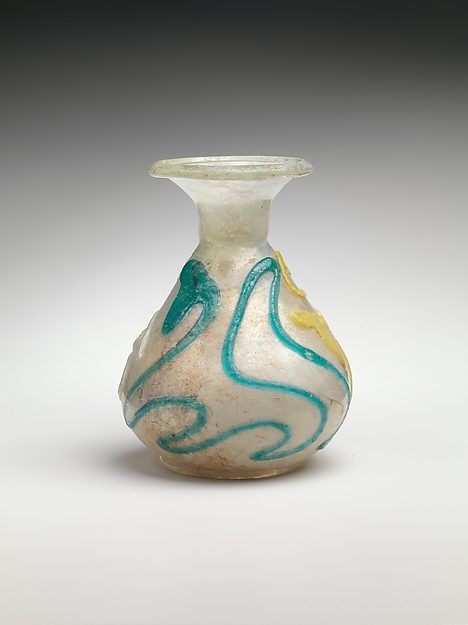
The snakes are easier to notice than the bottle. A turquoise line rises, bends, and loops across the pale glass; a yellow one curls beside it. A third trail nearly disappears because it has no strong color of its own. All three belong to a Roman flask only 10.5 centimeters high.
This is glass decorating glass. The flask’s body was blown, and its winding ornament was applied as separate trails. The Corning Museum of Glass defines snake-thread decoration by those sinuous applied lines, a technique used in Roman glassmaking between the second and fourth centuries CE.
Follow the line around the corner
The Met dates this example to the third century. Its catalogue describes notched surfaces on the trails, as well as heads and coiling tails. These details reward a closer look: the ornament is not simply a colored stripe drawn over an otherwise finished image. It projects from the vessel, catching light along its own edge.
In the photograph, the long turquoise trail appears to divide the lower body into irregular compartments. Some passages are wide and open; others narrow where the line doubles back. The bottle’s swelling outline makes those paths seem to change speed. A curve near the front is easy to follow, while one turning toward the side quickly slips from view.
That is an effect of looking at a decorated volume rather than a flat sheet. No single photograph can present every part of the design with equal clarity. The Met’s collection page supplies several views, so the eye can continue its journey around the object.
A second design you cannot easily see
Inside the flask, at the base of its neck, is a constriction. That less conspicuous feature helps explain the name “dropper flask.” In its catalogue of ancient glass, the Getty discusses this class of vessel: an internal diaphragm restricted the flow, allowing liquid to emerge in drops. The contents are thought to have included costly liquids such as oil or perfume, but that does not identify what this particular bottle once held.
The exterior and interior therefore work at different scales. Outside, long lines travel freely over a broad surface. Inside, a narrow opening controls a very small amount of liquid. The flourish and the restriction occupy the same object.
There is also a geographical contrast. The Met associates the blue-and-yellow decoration with production at Roman Cologne, while noting that comparable dropper forms are especially common in the eastern Roman world. That is evidence about types and workshop traditions, not a documented itinerary for this bottle.
The most useful way to examine it is to alternate between those two questions: where does the decoration lead your eye, and where would the liquid have gone? The answers reveal two kinds of intelligence in a very small piece of glass.
Object & sources
Glass snake-thread dropper flask
3rd century CE · Glass
- The Met: Glass snake-thread dropper flask
- Corning Museum of Glass: Snake-thread decoration
- Getty: Sprinkler Flask, catalogue 344
Historical information is drawn from the linked museum records and research. Visual observations are Storied Spark’s own. Storied Spark is independent of the institutions cited.
Comments
Post a Comment