Nine extraordinary fish in Louis Renard’s 1754 book reveal how observation, commerce, and imaginative color could share one printed page.
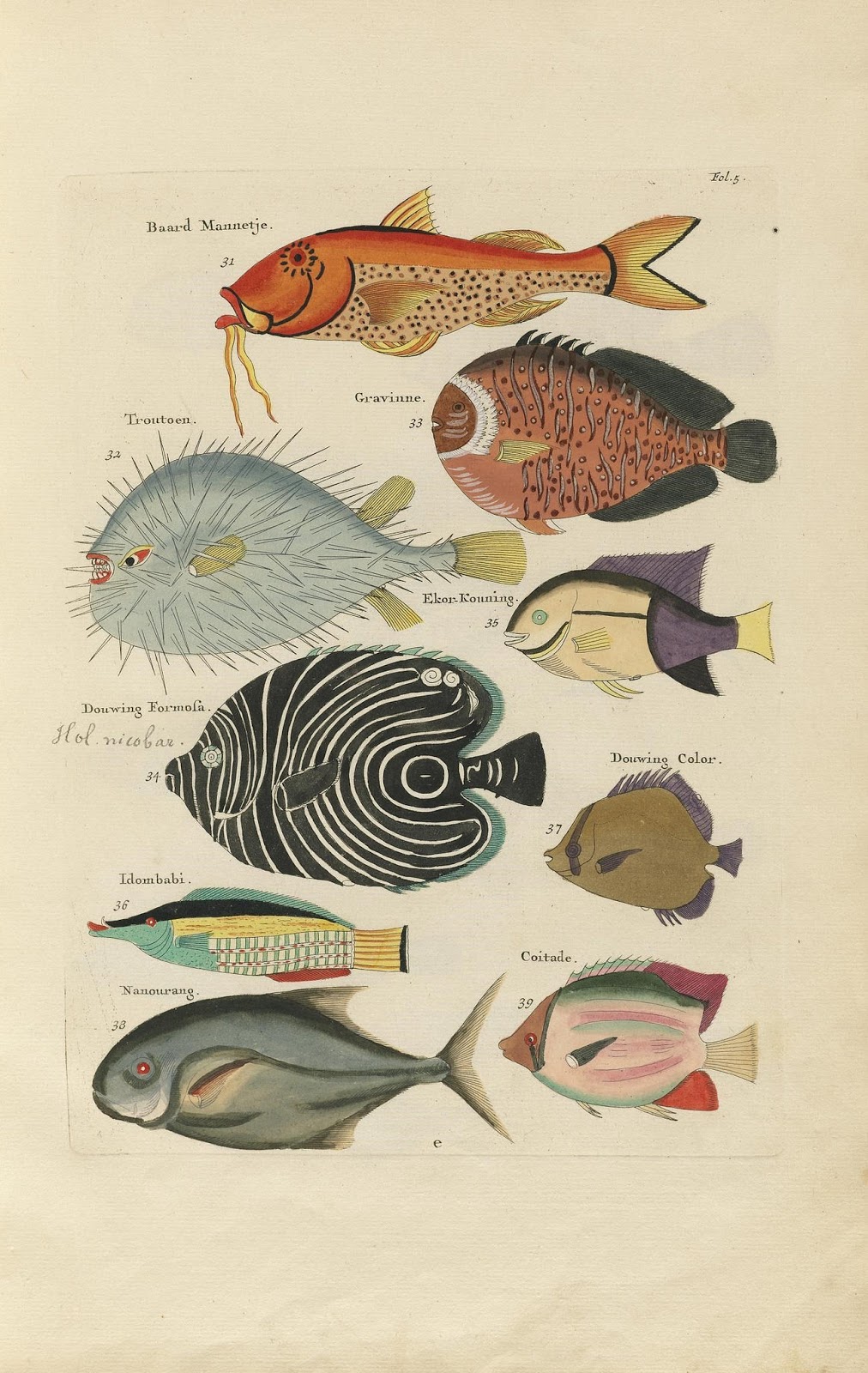
The fish at the center-left seems designed to test how much pattern one body can hold. White lines sweep across its black side, curling into loops near the tail. Above it, a spiny gray fish opens a mouth full of tiny teeth. At the top, a long red-and-yellow fish wears spots and two trailing barbels.
Nine creatures occupy this page, each with a number and name. It is plate 5 from the first volume of the 1754 edition of Louis Renard’s Poissons, ecrevisses et crabes. The digitized copy belongs to Harvard’s Ernst Mayr Library and is available through the Biodiversity Heritage Library.
The publisher did not travel with these fish
Renard published the work in the Netherlands using earlier drawings. Many came from Samuel Fallours, a Dutch artist who lived on Ambon in what is now Indonesia. Smithsonian Ocean describes how local fishermen supplied him with fish and how his pictures traveled through colonial trading and collecting networks to European buyers.
That journey matters. A printed image is the endpoint of several encounters, not a transparent window onto one. A fish was obtained, studied, drawn, sold, copied, engraved, and colored. Different people contributed knowledge and different opportunities for alteration entered along the way.
The book is famous for its imaginative departures. The Biodiversity Heritage Library discusses exaggerated colors and forms, as well as outright inventions elsewhere in the publication. Yet the Smithsonian notes that many of the pictured fish remain recognizable. Useful observations and unreliable embellishment can coexist within the same historical source.
A page that rewards delight and doubt
On this particular sheet, the separate silhouettes are exceptionally easy to compare. A narrow fish runs across the lower left like a ribbon. Its neighbor below is broad and dark, with a deeply forked tail. The right-hand column stacks rounder bodies at different heights. Pale spaces keep their outlines distinct even when the colors compete.
Our visual reading is that the arrangement invites the pleasure of a collection. Each fish is different enough to feel like a new discovery, while the shared background and small labels make the group appear orderly. That order can lend the pictures an authority their coloring does not necessarily deserve.
It would be tempting to correct the whole page by sorting the fish into “real” and “imaginary.” The surviving object asks for something more patient. Body shape, fin placement, written description, and color might not all be equally reliable. A skeptical reader can examine those features separately rather than accepting or rejecting every part together.
The black fish with white curls is still a marvelous place to begin. Follow one stripe until it bends, then compare that bend with the outline of the body. You can enjoy the drawing’s visual intelligence without treating every painted detail as a trustworthy field observation. The page becomes richer when curiosity includes both questions: What am I seeing, and how did this image reach me?
Artwork & sources
Poissons, ecrevisses et crabes, volume I, plate 5, figures 31–39
Published under Louis Renard’s name; imagery from earlier drawings, including work by Samuel Fallours · 1754 second edition · Hand-colored engraved book illustration
Ernst Mayr Library, Museum of Comparative Zoology, Harvard University, digitized through the Biodiversity Heritage Library. Louis Renard, Poissons, ecrevisses et crabes, 1754, volume I, plate 5, BHL page 50095031.
View the source object. Image: Public domain; BHL holding-institution metadata.
- Biodiversity Heritage Library: Renard’s Book of Fantastical Fish
- Smithsonian Ocean: Fish Illustrations
- Harvard / Internet Archive: digitized book and rights metadata
Historical and scientific details are grounded in the sources above. Interpretations of composition are Storied Spark’s own readings. Storied Spark is independent of the collecting institutions.
Comments
Post a Comment