A small Japanese lacquer case carries a shoreline across four stacked compartments, held together by an ingenious cord and bead.
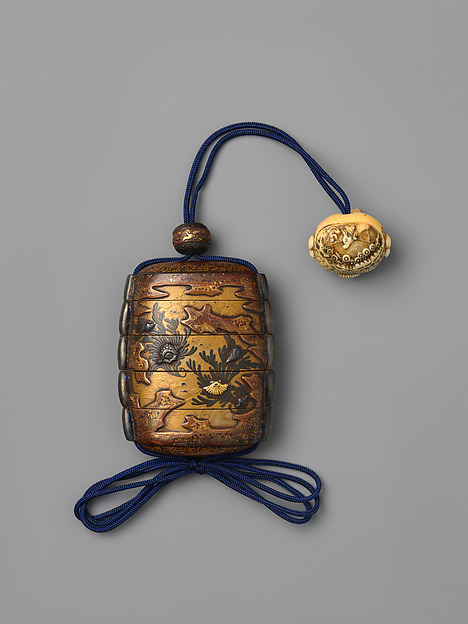
A shoreline fills this tiny case. Rocks, shells, seaweed, and moving water occupy a surface only 7.8 centimeters high. Then three horizontal joins reveal another order beneath the scenery: the picture extends across four stacked compartments.
The object is an inrō, made in Japan in the seventeenth or eighteenth century. The Met identifies its body as lacquered wood, with several gold and silver decorative techniques. It is a small container constructed to be carried, opened, closed, and seen at close range.
The cord is part of the design
The blue cord in the photograph makes the carrying system visible. Traditionally, a cord linked the container to a toggle called a netsuke. The netsuke rested over the wearer’s obi sash, anchoring the suspended object. A sliding bead, the ojime, helped secure the stacked sections.
The Met’s account of these accessories explains that inrō held small necessities such as medicine or seals. Moving the bead along the cord made the compartments accessible. The parts worked together: case, cord, bead, and toggle formed a portable system.
That changes the way the picture reads. Its seams are not defects in a continuous image. They are the points at which the image has to cooperate with a useful object. A band of water can cross from one section to another, while the fitted edges still allow the case to come apart.
Several kinds of shine
The catalogue’s material description is unusually rich. It lists raised, flat, and polished-out forms of gold and silver lacquer decoration, together with applied gold foil and silver inlay. The accompanying bead combines copper, other metal inlay, and gilded details; the netsuke is carved ivory.
These varied materials give the ensemble several kinds of texture and reflection. The case, bead, and toggle do not look like three pieces made from a single uniform substance.
In the photograph, dark contours interrupt the gold-toned ground, and small bright passages give the shoreline an uneven sparkle. The rounded corners keep the whole case compact. Along each side, the cord follows its edge rather than cutting across the picture.
The scale is easy to lose on a screen. At actual size, a viewer would need to approach closely to distinguish many of these details. Its visual impact depends on a second look, after the larger shape has already registered.
Inrō and netsuke could also signal wealth and taste, as the Met’s historical overview makes clear. The record does not identify the original owner of this particular ensemble.
What survives is specific enough: an elaborate shore, divided into usable compartments, with a fastening system that is itself worth looking at. The artistry includes both the picture and the way the picture opens.
Object & sources
Inrō with Shells and Seaweeds amid Rocks and Waves
17th–18th century · Inrō: four cases; lacquered wood, gold and silver takamaki-e, hiramaki-e, togidashimaki-e, cutout gold foil application, silver inlay on gold ground; metal cord runners; ojime: copper with mixed-metal inlay and gilded details; netsuke: carved ivory
- The Met: Inrō with Shells and Seaweeds amid Rocks and Waves
- The Met: Netsuke, From Fashion Fobs to Coveted Collectibles
Historical information is drawn from the linked museum records and research. Visual observations are Storied Spark’s own. Storied Spark is independent of the institutions cited.
Comments
Post a Comment