A seventeenth-century Indian water-pipe base reveals why darkening one metal can make another metal’s floral pattern shine.
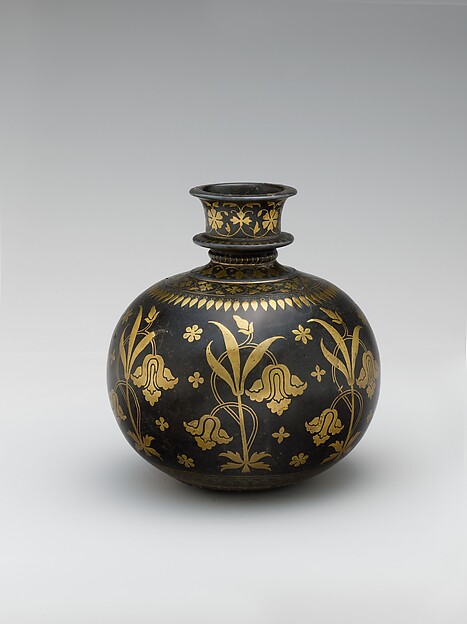
The flowers look bright because the surface around them is dark. On this Indian vessel, that contrast is not a lighting accident or a layer of black paint behind a golden drawing. It is the result of a metalworking process designed to make two materials behave differently.
The object is a late-seventeenth-century base for a water pipe, or huqqa, made in Bidar in the Deccan. The Met identifies its materials as a cast zinc alloy inlaid with brass. The familiar name for this kind of work, bidri, connects the technique to Bidar.
Darkening the ground
In bidri work, an artisan cuts a design into the metal body and inserts another metal into the prepared spaces. Chemical treatment darkens the surrounding alloy, leaving the inlaid ornament to stand out. The Met’s record of this base explains that relationship directly: the darkened ground highlights the metal flowers.
The museum’s catalogue on the Deccan sultanates places the craft within a broader range of objects, including ewers, trays, boxes, and water-pipe bases. It also notes the difficulties of assigning precise dates and origins to early bidri. A distinctive appearance does not mean that every stage of the craft’s history is securely documented.
This base makes a particularly clear demonstration. The main flowers occupy generous dark intervals. Smaller blossoms sit between the larger stems, while narrow decorative bands gather around the shoulder and neck. The broad body has room for a slower pattern; the smaller parts carry a quicker one.
Drawing on a round surface
Follow a stem from the lower body. It divides and curves outward before ending in a drooping flower. Nearby, pointed leaves rise in the opposite direction. In the photograph, those opposing movements keep the pattern from reading as a row of isolated botanical specimens.
The rounded body also edits what we can see. Flowers near the center face us clearly; those at the sides become narrower as the vessel turns away. The decoration was made for an object that could be encountered from several angles, not for this one fixed photograph.
The Met’s earlier acquisition account notes that bidri designers drew on textiles and architectural ornament, adjusting motifs for different objects. Here, a repeated flower does not stay geometrically identical in appearance as it travels around the swelling form. Surface and pattern have to be considered together.
A base rather than a complete vessel
The opening at the top once connected to other components. The museum explains that a long stem would have supported a brazier, with a pipe for smoking. What survives in this display is the base, not the complete apparatus.
That missing equipment gives the surviving body a misleading self-sufficiency: it can look like a finished vase. Knowing its function changes its proportions. The short neck was a connection point in a taller assembly.
The flowers still command attention. Their brilliance comes from a decision about everything around them. Sometimes the most consequential part of a decorative process is what an artisan chooses to make recede.
Object & sources
Base for a Water Pipe (Huqqa) with Irises
late 17th century · Zinc alloy; cast, engraved, inlaid with brass (bidri ware)
- The Met: Base for a Water Pipe with Irises
- The Met: Sultans of Deccan India, bidri section
- The Met: Notable Acquisitions 1984–1985
Historical information is drawn from the linked museum records and research. Visual observations are Storied Spark’s own. Storied Spark is independent of the institutions cited.
Comments
Post a Comment