A bold checkerboard tunic rewards a closer look: its inside, seams, and smallest border received extraordinary attention.
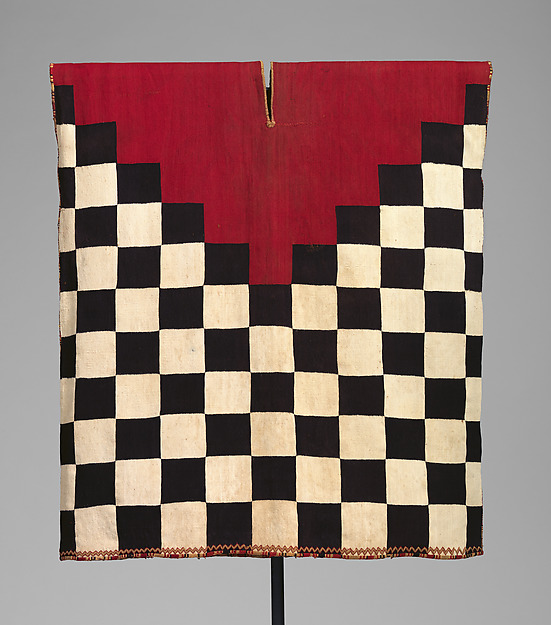
At a distance, this tunic makes a forceful statement with very few elements: pale squares, dark squares, and a deep red V. Up close, a different achievement emerges. The garment was carefully finished on both sides, including surfaces that a wearer could keep hidden.
The Met dates the camelid-fiber tunic to 1400–1535 CE and identifies its maker as an Inca artist. Its possible place of origin spans present-day Argentina, Bolivia, Chile, or Peru. The broad geography is worth retaining: the label describes an imperial textile tradition, without claiming a workshop location that the evidence cannot establish.
The design continues inside
According to the object record, the checkerboard appears on front and back, inside and outside. The cloth was woven as one panel. A temporary yarn kept the future neck opening closed during weaving; removing it released the slit. Fine, double-faced embroidery then covered seams and edges.
Those finishing steps matter because a garment is more than its broadest visible surface. A seam can be strong yet look abrupt. An edge can stop a pattern without feeling resolved. Here, tiny bands of color bring the joins into the same world of exacting work as the large squares.
The distinction is visible even in a photograph. The dark-and-light blocks announce the overall structure. The narrow lower border asks you to move closer. Between them, a small zigzag introduces a different rhythm: a quick, repeated change of direction beneath the steadier grid.
Cloth as public identity
This was not merely a pattern selected for private pleasure. Fine tunics were connected to identity, rank, and the Inca state. Textiles circulated as gifts and rewards, including recognition for military achievement. The checkerboard has a particular military association in a Spanish account of the 1532 encounter at Cajamarca.
That association should not become a claim that all Inca soldiers wore identical uniforms. The Met’s Andean tunic exhibition makes that caution explicit. Its discussion also notes that many Inca textiles were finished without the loose reverse-side ends familiar from European tapestry traditions. “Wrong side” is an unhelpful assumption to bring to such a carefully resolved object.
The visual balance is equally deliberate. The red area descends in steps that follow the squares, then ends in a point. It does not need a drawn outline to separate itself from the checkerboard. The repeated unit supplies the boundary.
Yet precision does not mean we can translate every detail. The Met notes that the exact significance of the lower zigzag remains unknown. We can describe where it sits, how it is made, and how it relates to the rest of the garment without inventing a message for it.
Perhaps the most revealing shift is to stop treating the tunic like a flat graphic. It was made to surround a body, with a front, a back, an inside, and moving edges. The weaver’s attention followed the cloth all the way around.
Object & sources
Tunic
1400–1535 CE · Camelid fiber
Historical information is drawn from the linked museum records and research. Visual observations are Storied Spark’s own. Storied Spark is independent of the institutions cited.
Comments
Post a Comment