Bonheur’s enormous horse-market painting combines repeated observation with a tightly controlled surge of bodies and movement.
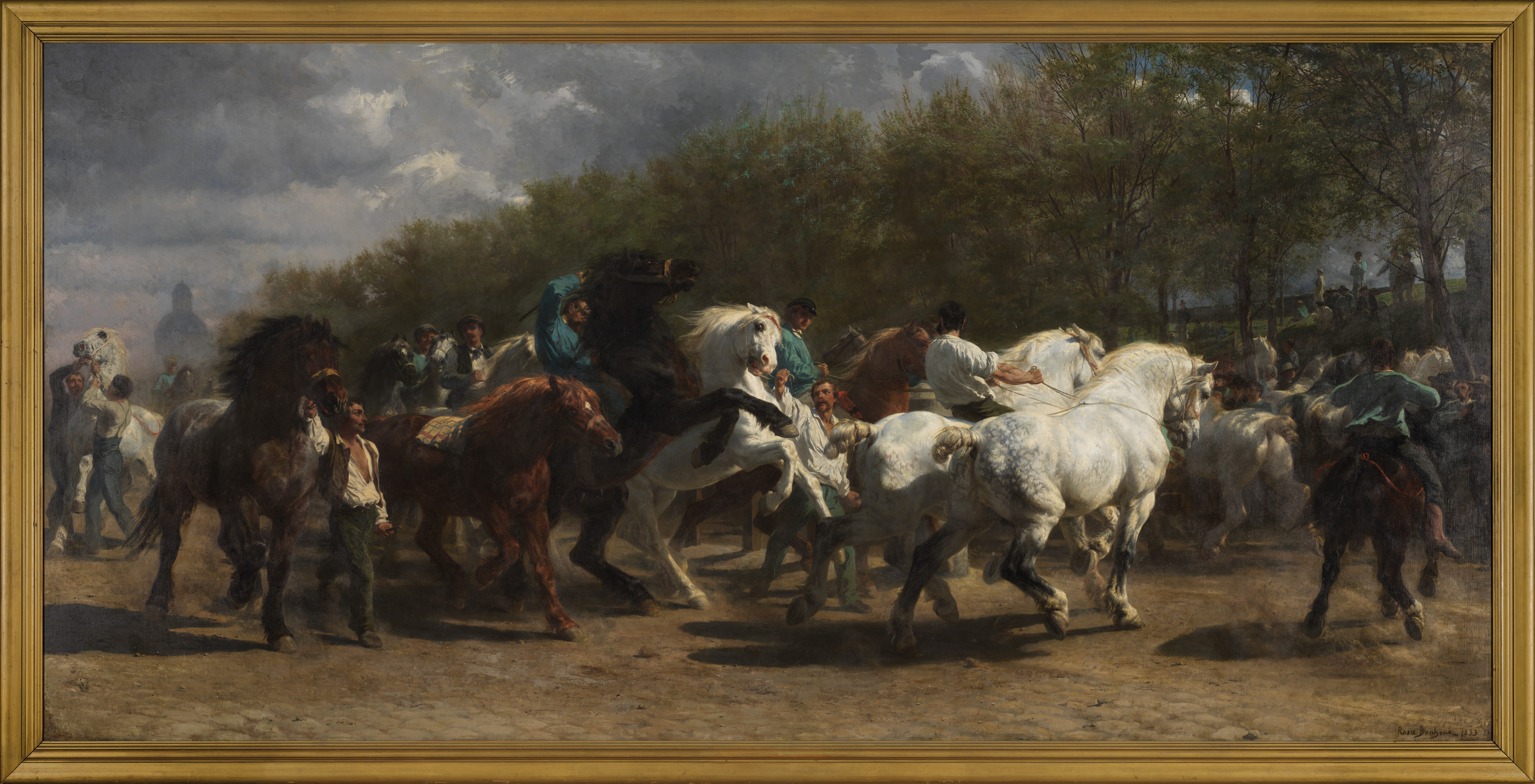
A white horse twists, a dark horse lifts its front legs, and several heavy bodies press across the foreground. Rosa Bonheur’s The Horse Fair feels crowded with movement. The extraordinary thing is how readable that movement remains. Each new neck, flank, and set of legs adds energy without turning the scene into an indistinct mass.
The painting is enormous: a little over five meters wide. Bonheur began it in 1852, exhibited it at the Paris Salon in 1853, and revised it in 1855. The Met dates the finished work to 1852–55. Its scale gives an ordinary commercial gathering the presence of a major public event.
Returning to the same place
The subject is the horse market on the Boulevard de l’Hôpital in Paris. The Salpêtrière appears in the left background. According to The Met, Bonheur visited the market twice a week for a year and a half to sketch, wearing men’s clothing to attract less attention. The liveliness of the painting grew from repeated study, not simply from a single lucky view.
That distinction can change the way we think about immediacy. A picture may feel instantaneous while depending on long familiarity. Here, the horses show different attitudes and directions. Their bodies provide a range of forms that would be difficult to study simultaneously in a moving crowd.
Look first at the pale horses near the center. Their bright backs and flanks separate them from darker neighbors and draw attention toward the thick of the activity. Then follow the darker animals outward. Their silhouettes connect the central group to the edges, carrying the movement across the long canvas.
Strength in opposing directions
The handlers do not all face the same way, and the horses do not all submit to one simple line. Reins, arms, turned heads, and leaning bodies set up opposing pressures. The picture’s energy comes partly from these disagreements. A parade of identical poses would tell a much quieter story.
Behind the action, the bank and trees provide a steadier boundary. The spectators are smaller and less insistent than the horses in front. That contrast makes the foreground seem more immediate: the people watching are safely within the scene, while the largest animals appear close to our own position outside it.
Bonheur also looked beyond the market. The Met names ancient Greek sculpture among her influences and records her comparison of the work to a Parthenon frieze. That reference points toward the painting’s carefully organized procession. Observation supplied material; composition decided how the bodies would move together.
The image traveled in other forms, too. The National Park Service records that the American collector Frederick Billings bought an engraving after The Horse Fair in 1871. A scene created on a monumental canvas could enter a much smaller domestic setting through print.
That change of size does not remove the central achievement. Even on a screen, the horses retain separate weights and attitudes. Bonheur makes a crowd feel powerful by allowing its members to remain distinct. The rush is collective; the looking was specific.
Artwork & sources
The Horse Fair
Rosa Bonheur · 1852–55
Oil on canvas
The Metropolitan Museum of Art. Gift of Cornelius Vanderbilt, 1887. Object 87.25.
View the collection record. Image: Public domain; The Met Open Access, CC0.
Historical details are grounded in the linked collection records and museum research. Visual interpretations and any creative exercises are original Storied Spark contributions. Storied Spark is independent of these institutions.
Comments
Post a Comment