A quiet Japanese print conceals a practical puzzle: the long and short months of 1765, embossed into a robe.
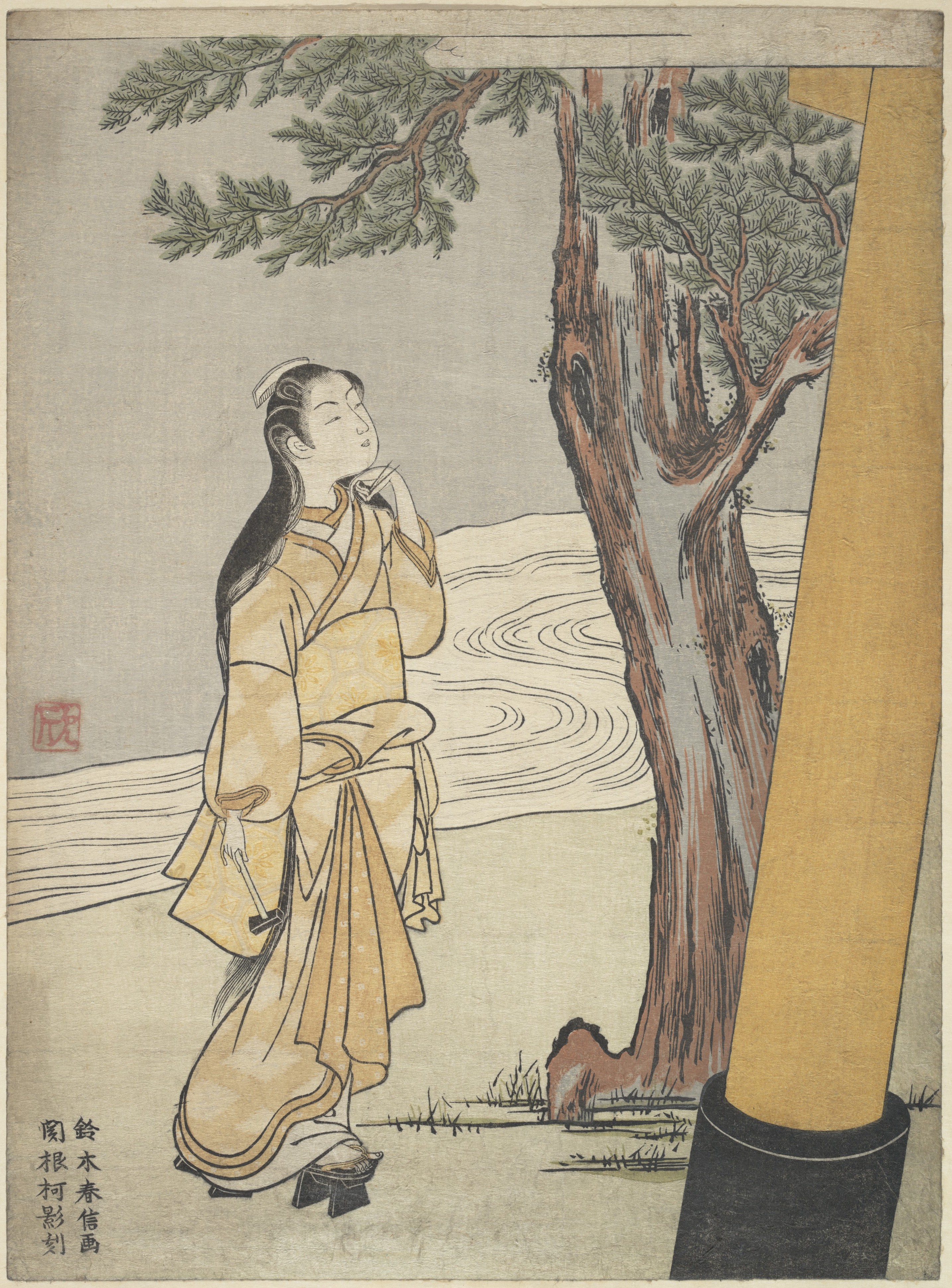
This picture is a calendar, but looking for a grid will not help. The year’s useful information is hidden in the pale pattern of a woman’s kimono. Some of it is difficult to read even when you know where to look. The puzzle is built into the surface of the paper.
Suzuki Harunobu’s Visit to a Shrine at the Hour of the Ox was made in 1765. The Met identifies it as an e-goyomi, or picture-calendar. Numbers for the year’s long months appear in the upper part of the robe, with those for the short months below. Instead of being printed in a contrasting color, they were embossed without ink. Some characters are now illegible.
A calendar without the calendar look
The information mattered because the Japanese calendar did not follow the fixed month-length pattern familiar to readers of a modern Gregorian calendar. Months could be twenty-nine or thirty days, and knowing which were long and short required the appropriate year’s arrangement. A compact list of those months could therefore do useful work without supplying a separate square for every day.
Picture-calendars also belonged to a social culture of exchange. The Art Institute of Chicago’s study of surimono, privately commissioned prints, describes early Harunobu calendar impressions as gifts for literary or social circles. Their month designations were worked into the pictures rather than displayed as conspicuous calendar headings. Government control over commercial calendar publication formed part of that setting.
These were opportunities for an image to be admired and decoded. The University of Michigan Museum of Art connects deluxe calendar commissions in 1765 with the emergence of full-color nishiki-e prints. Private patrons helped support an unusually rich printed object, and the little visual puzzle became part of a larger development in color printing.
Two kinds of hidden meaning
The scene itself holds another surprise. The woman carries a hammer and nails associated with a nocturnal curse ritual. According to The Met, the “hour of the ox” falls around two in the morning. Harunobu leaves out some customary accessories, including the straw effigy, and the museum notes the figure’s unusually quiet demeanor. The image does not present an uncomplicated account of the ritual.
Visually, that restraint gives the picture an odd tension. Her curved silhouette faces the rough vertical trunk. A huge yellow pillar at the right edge crops the scene sharply, while the robe’s flowing lines soften its center. Before reading the museum record, a viewer could easily notice the elegance of the arrangement and miss the unsettling errand entirely.
The month numbers add a second delay. The print can be read as a figure in a setting, then as a story, then as information concealed in a decorative surface. Those readings do not cancel one another. They make the same small sheet perform several jobs.
A screen reproduction also reminds us of what photographs leave out. Embossing changes the paper’s relief, so subtle shadows and the angle of light affect what can be seen. If you cannot decipher the numbers in this image, that is not a failed treasure hunt. The museum itself warns that they are hard to read.
The ingenious part is not merely that a calendar has been hidden. It is that noticing how the object was made becomes part of learning what the picture is.
Try it: Hide a harmless date in a pattern
Draw a border of leaves, ribbons, or geometric shapes. Work the numbers of a meaningful date into it so they remain discoverable. Give someone a clue. Keep the information playful; a decorative puzzle is not a secure way to conceal private data.
Artwork & sources
Visit to a Shrine at the Hour of the Ox (Ushi no toki mairi)
Suzuki Harunobu · 1765
Woodblock print; ink and color on paper
The Metropolitan Museum of Art. The Howard Mansfield Collection, Purchase, Rogers Fund, 1936. Object JP2438.
- The Met: the exact 1765 picture-calendar
- Art Institute of Chicago: Surimono, an introduction
- University of Michigan Museum of Art: a 1765 calendar print
Image: Public domain; The Met Open Access, CC0. Image-use terms.
Historical information is drawn from the linked collection and research records. Visual readings and creative prompts are original Storied Spark contributions. Storied Spark is independent and is not affiliated with the museums.
Comments
Post a Comment