A discarded uniform and a simplified scythe complicate the bright harvest in Homer’s 1865 painting of a returning soldier.
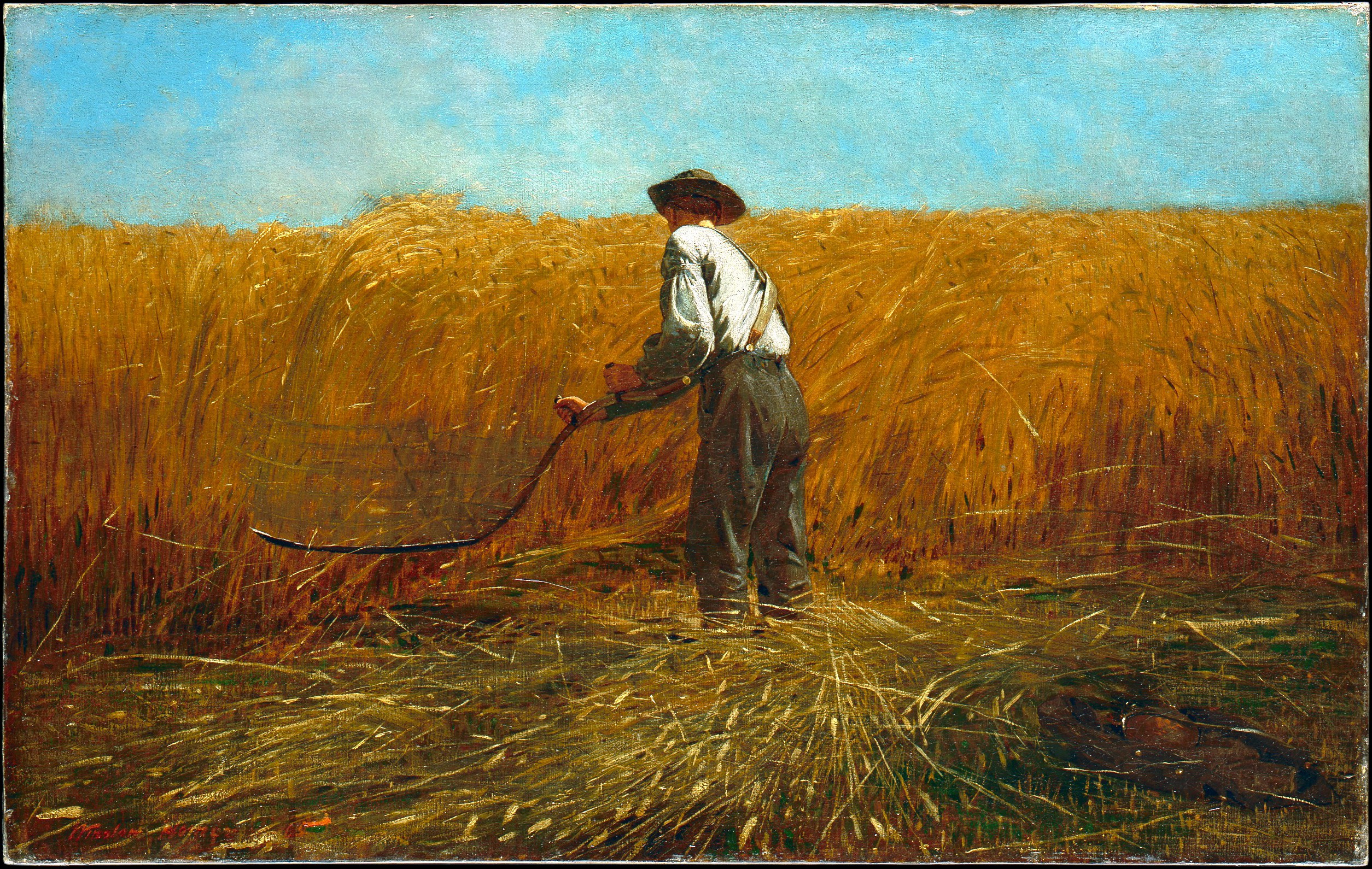
The sky is bright, the wheat is tall, and the man has work to do. At first, Winslow Homer’s The Veteran in a New Field can look like a straightforward picture of a harvest. Its title asks us to look again. This worker has come from another kind of field.
Homer painted the canvas in 1865, the year the American Civil War ended and Abraham Lincoln was assassinated. A Union Army jacket and canteen lie at the lower right. The Met identifies those small objects as the evidence that the farmer is a returning soldier. They are easy to overlook beside the wide sweep of gold.
The past at the edge of the picture
The uniform is not displayed prominently on the man’s body. It has been put aside, close to the frame. Visually, that placement allows his present activity to dominate without removing his earlier life from the scene. The distinction matters: laying something down is not the same as making it cease to exist.
We see the worker from behind. His face does not tell us whether he is relieved, grieving, exhausted, or absorbed in the job. Rather than assigning him a private emotion, the picture lets the relation between objects do much of the storytelling. A shirt, a tool, a field, and a discarded uniform provide enough information to make the moment historically specific.
The wheat forms a broad band between the cut stalks and the open sky. Against it, the pale shirt becomes a clear point of attention. The man’s arms and the long handle lead the eye outward into his labor. He is small compared with the field, but the movement of his body gives that larger space a purpose.
A tool with two meanings
The scythe also has a history within the painting. The Met’s account of changes to the work explains that Homer originally painted a more elaborate version and then simplified it. The earlier form can still be detected because the paint above it has become partly transparent.
The museum connects the resulting single blade with the traditional image of the Grim Reaper. That is an art-historical interpretation, rather than proof of a single meaning in Homer’s mind. Nevertheless, the visual tension is strong: the same cutting tool serves the harvest and recalls death.
Curator Stephanie Herdrich reads the return to productive work as a source of hope after devastation. The painting allows that hope without making it uncomplicated. The wheat suggests plenty, while the soldier’s belongings and the blade remain in view. Its quietness holds several associations together.
The small dark corner changes the large bright field. Cover it briefly, and the scene becomes less specific. Reveal it again, and ordinary work acquires a before and an after. Homer places the crucial information where a patient viewer can find it, then leaves the rest of the canvas to show a life continuing.
Artwork & sources
The Veteran in a New Field
Winslow Homer · 1865
Oil on canvas
The Metropolitan Museum of Art. Bequest of Miss Adelaide Milton de Groot (1876-1967), 1967. Object 67.187.131.
View the collection record. Image: Public domain; The Met Open Access, CC0.
- The Met: The Veteran in a New Field
- Stephanie Herdrich: Art for Solace
- Met Custom Prints: museum artwork account
Historical details are grounded in the linked collection records and museum research. Visual interpretations and any creative exercises are original Storied Spark contributions. Storied Spark is independent of these institutions.
Comments
Post a Comment