A small Akan brass weight reveals a system in which gold dust was money and a patterned object helped establish its value.
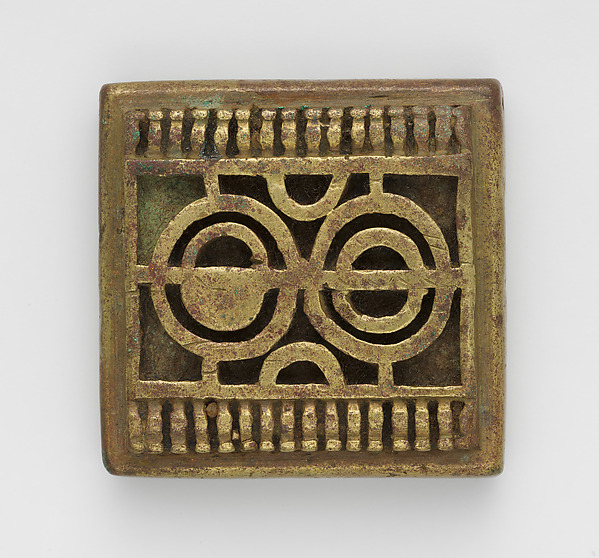
A “gold weight” need not contain gold. This small square example is brass. Its job belonged to a system in which the valuable material was placed on the other side of a balance: gold dust, measured for exchange.
Made by an Akan artist in the eighteenth or nineteenth century, the weight is less than five centimeters wide. The Met associates it with the region of present-day Ghana and Côte d’Ivoire. Enlarged on a screen, its ridges and recesses may resemble architectural ornament. In the hand, it would be a compact tool.
Money measured by a balance
The British Museum’s account of gold-weights places the practice in West Africa before European traders reached the coast in the late fifteenth century. Akan-speaking communities made weights in both abstract and representational forms. The objects belonged to established systems of trade, rather than being curiosities created for later collectors.
Weighing required a set of related equipment. The Met describes scales, storage boxes, spoons, and weights as parts of the process. Once you imagine those tools together, the little brass square becomes easier to understand. It helped turn a quantity of loose material into a transaction that people could evaluate.
A comparable geometric weight in the Cleveland Museum of Art has softened edges that its curators interpret as signs of frequent use. That observation concerns the Cleveland example, not the one pictured here. It is nevertheless a useful reminder that these objects passed through hands and worked beside balances; their histories were practical as well as visual.
A pattern without a surviving key
Look at the two round structures on the Met weight. A horizontal bar cuts across both, but the shapes within them are not quite identical. Above and below, short parallel ridges create denser bands. The middle feels open and spacious by comparison.
The resulting pattern is easy to remember. It is much harder to read as a specific statement. The Met’s current discussion cautions that the meanings of most geometric designs are unknown. Similar patterns on other weights may have carried numerical information, but that possibility does not supply a value for this object.
The technique offers a firmer starting point. Lost-wax casting begins with a modeled form, usually in wax, enclosed in a mold. The wax is removed through heating, and molten metal takes its place. The model is therefore absent from the finished object, while its decisions survive in the brass.
Even the category “gold weight” has become more nuanced. The Met notes scholarship suggesting that some representational pieces may have circulated as objects of conversation rather than functioning primarily as measures. A familiar museum name can contain several histories.
This geometric example invites a simpler, grounded question: how much visual care can a measuring tool hold? Its answer is there in the changing depth, the paired circles, and the narrow rhythm of the ridged border.
Object & sources
Geometric gold weight
18th–19th century · Brass
- The Met: Geometric gold weight
- British Museum: Gold-weight terminology
- Cleveland Museum of Art: Geometric gold weight, 1962.244
Historical information is drawn from the linked museum records and research. Visual observations are Storied Spark’s own. Storied Spark is independent of the institutions cited.
Comments
Post a Comment