Birds, berries, and looping stems: how William Morris turned a small garden drama into an intricate repeating textile.
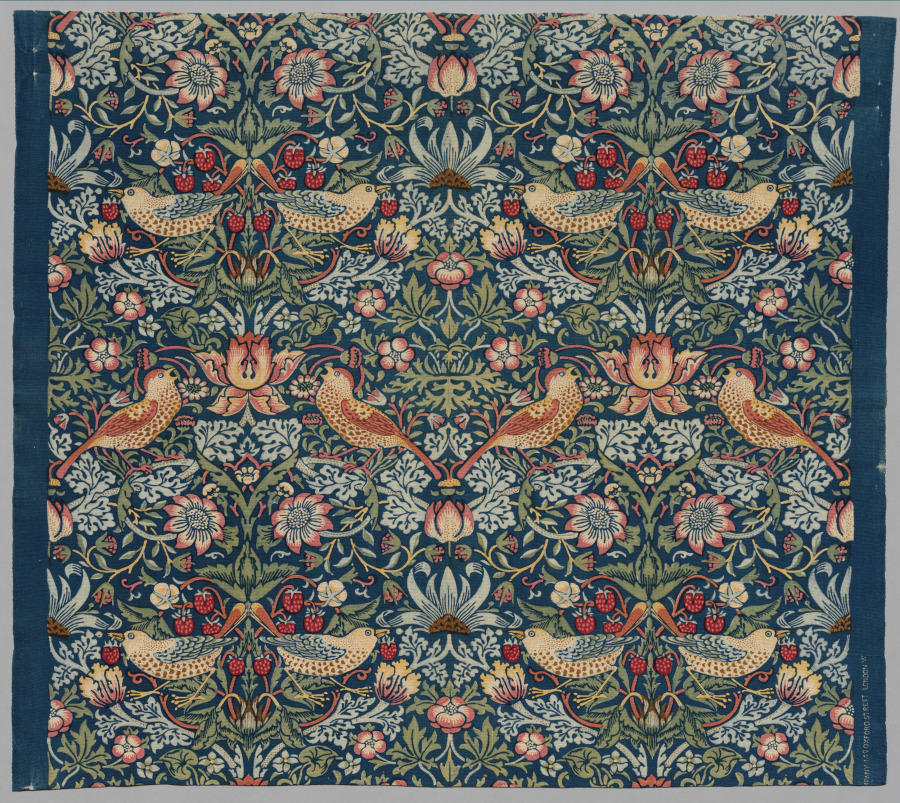
The birds are behaving badly, but the pattern gives them excellent manners. They face one another in balanced pairs, turn away in matching poses, and fit neatly into a garden of curling stems. In William Morris’s Strawberry Thief, a little disruption becomes the basis of an orderly design.
Morris developed the pattern in 1883. The piece pictured here, however, was printed around 1936, decades after his death. The Cleveland Museum of Art’s record makes that distinction: the design belongs to Morris, while this particular length of cotton belongs to its long manufacturing afterlife. A familiar historical design and the surviving object carrying it need not share a date.
Blue comes before the birds
The title refers to the thrushes at Kelmscott Manor, Morris’s country home. Cleveland’s account connects the pattern to those garden visitors and explains its indigo-discharge process. The cloth was first dyed blue, then selectively bleached and block printed. The dark ground was therefore part of the making, rather than simply the last background color added around completed flowers.
That sequence changes how the textile can be read. The pale shapes look like small clearings in the blue. Fine foliage opens passages around larger flowers; the birds occupy broader islands of warm color. There is very little empty space, yet the dark ground keeps returning between the stems, separating one small incident from the next.
Find a pair of birds and then look above or below them. Their arrangement changes as the pattern travels. Some turn toward a central flower; others present their backs to one another. The repetitions are easy to recognize, but following them requires the eye to move between several kinds of shape. A repeat can be predictable without offering everything at the first glance.
The rhythm inside the abundance
Try looking at the image from farther away. Individual berries become harder to distinguish, while larger curves and paired bodies remain. Close up, it is a garden full of incidents. At a distance, it behaves more like a woven-looking framework of mirrored forms. This is a visual effect of the design, not a claim that the cotton itself was woven into pictures: the museum identifies it as printed plain weave.
Morris’s devotion to skilled production also carried a difficulty. As Cleveland curator Cory Korkow explains, good materials and properly paid labor made the original goods expensive for the ordinary households he hoped to improve. The pattern’s appeal does not erase that tension. Beauty, workmanship, and affordability were connected problems.
The birds give the design its name, but they cannot do the whole job. Remove the stems and the repeat would lose its paths; remove the dark intervals and the shapes would crowd together. The pleasure lies in the way an immediately charming subject rests inside a carefully managed structure. A stolen strawberry is the event. The entire surface keeps it happening.
Artwork & sources
Strawberry Thief
William Morris, designer · design 1883; this textile ca. 1936
Plain weave cotton, discharge printed
The Cleveland Museum of Art. Gift of Mrs. Henry Chisholm, 1937.696.
View the collection record. Image: Public domain; Cleveland Museum of Art Open Access, CC0.
Historical details are grounded in the linked collection records and museum research. Visual interpretations and any creative exercises are original Storied Spark contributions. Storied Spark is independent of these institutions.
Comments
Post a Comment